
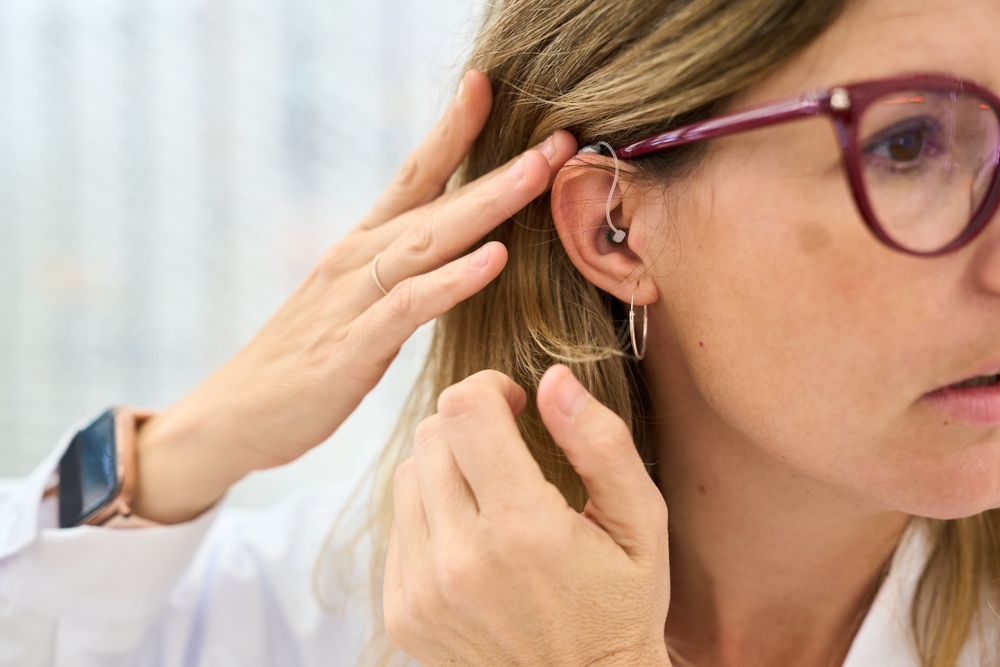
A primary reason individuals put off addressing auditory deficits is the assumption that assistive devices will be unsightly or awkward to wear. Such reluctance is perfectly natural when you consider past technology! In some cases, people even worried that they might be left out of conversation altogether by others who assumed they wouldn’t be able to hear or comprehend.
Because this archaic mental image endures, thousands remain deeply reluctant to schedule an initial audiometric evaluation. But the reality is that today’s modern hearing aids look and feel very different from what you might expect. Ongoing innovations in cosmetic engineering mean today’s options are ultra-small, seamlessly comfortable, and beautifully hidden from public view.
If you’ve been putting off treatment because of how hearing aids used to look, it might be time to take a fresh look at what’s available today!
Dispelling the Myth: Modern Devices Have Transcended Older Styles
If you close your eyes and picture a hearing aid, you might imagine something large, hooked over the ear, and visible from across the room. If that is the visual you hold, you are fundamentally remembering outdated medical equipment from decades past.
In the intervening decades, the entire field of otolaryngology and acoustic engineering has undergone a massive paradigm shift. Continuous refinements in ergonomic styling, nanometer-scale circuitry, and digital audio engineering have radically overhauled the modern cosmetic profile. The resulting devices are beautifully downsized, highly aerodynamic, and built to match lifestyle needs by remaining completely hidden.
A substantial percentage of contemporary options reside deep within the auditory canal, ensuring absolute invisibility during routine face-to-face interactions. Alternatively, post-auricular models are constructed with such streamlined dimensions that they disappear against the scalp, customizable to complement individual skin and hair coloration.
Understanding Your Options: A Guide to Contemporary Device Form Factors
To understand how these sophisticated medical devices are physically configured, review this concise anatomical breakdown:
The Invisible-in-Canal (IIC) Form Factor
For total subtlety, these instruments have no medical equal. IIC devices sit completely inside the ear canal and are custom-made to fit your ear. Spoken interactions at arm’s length occur without anyone realizing a medical device is present. They’re a popular choice for people with mild to moderate hearing loss who prioritize subtlety.
Modern Standards: Receiver-in-Canal (RIC) / Receiver-in-the-Ear (RITE)
This architecture stands as the most frequently prescribed configuration in modern clinical practice. A micro-housing rests behind the upper pinna, transferring processed sound via an ultra-fine, translucent micro-wire to an acoustic driver nestled inside the canal. From an aesthetic standpoint, they look very similar to trendy consumer tech or modern bluetooth monitors. The vast majority of peers will fail to perceive the apparatus unless conducting a highly deliberate close-up inspection.
Behind-the-ear (BTE)
These sit fully behind the ear and are slightly larger, but they’re still far more streamlined than older versions. They are typically prescribed to resolve advanced levels of hearing impairment, generating exceptional sound amplification without the cumbersome weight users traditionally dread.
The bottom line is simple: modern assistive hearing systems are crafted to serve your life quietly, not to draw attention to your ears.
How Current Hearing Technology Outperforms Traditional Amplifiers
It is vital to recognize that this technological revolution is not simply a visual upgrade. Today, they function more like smart devices than traditional medical equipment. Many connect directly to your phone via Bluetooth, letting you stream calls, music, or even TV audio straight to your ears with no headphones needed.
Managed via intuitive phone interfaces, these systems give you the power to mix sound levels or change situational profiles without ever touching your ears. For instance, when entering a highly reverberant dining space, you can suppress ambient acoustic noise and sharpen speech clarity in mere moments. Convenient overnight charging systems have permanently replaced the tiny disposable batteries that patients traditionally struggled to replace. You merely dock the devices on a nightstand inductive charger, exactly like replenishing your mobile phone.
Getting Over the Fear and Stigma of Hearing Devices
Even knowing all of this, it’s easy to hesitate. Scheduling an appointment can feel like a profound internal challenge because it represents an open admission of sensory alteration. This realization can occasionally induce feelings of helplessness, leaving patients feeling detached from their own physical autonomy.
But here’s a different way to look at it: Hearing aids aren’t a sign that something has gone wrong. They are simply tools for managing standard lifecycle changes, which are a normal part of the human experience. Adopting this tech is definitive proof that you are actively taking charge of your health to empower and protect your daily cognitive function.
Visualize the freedom of utilizing a completely covert acoustic system that restores your ability to track jokes, engage in crowded restaurants, and capture every nuance of the activities you love. This is the definition of true personal empowerment!
See For Yourself What Today’s Hearing Aids Look Like
The most effective method to permanently banish an obsolete stereotype is to personally examine current clinical options. Our clinical team cordially invites you to visit our facility, interview our staff, and evaluate different form factors in a stress-free, zero-obligation environment. Treat this as a risk-free exploratory step to comprehend the incredible aesthetic shift that has occurred in our field.
You will likely be utterly delighted to discover how microscopic, physically seamless, and high-performing today’s options truly are! Do not let outdated myths delay your wellness—call our specialized practice or book your appointment online today.